Replacement Service
Short comic fiction: two model-railway enthusiasts arrange a replacement bus service, then furnish it with difficulties.
Short fiction by Ansel.
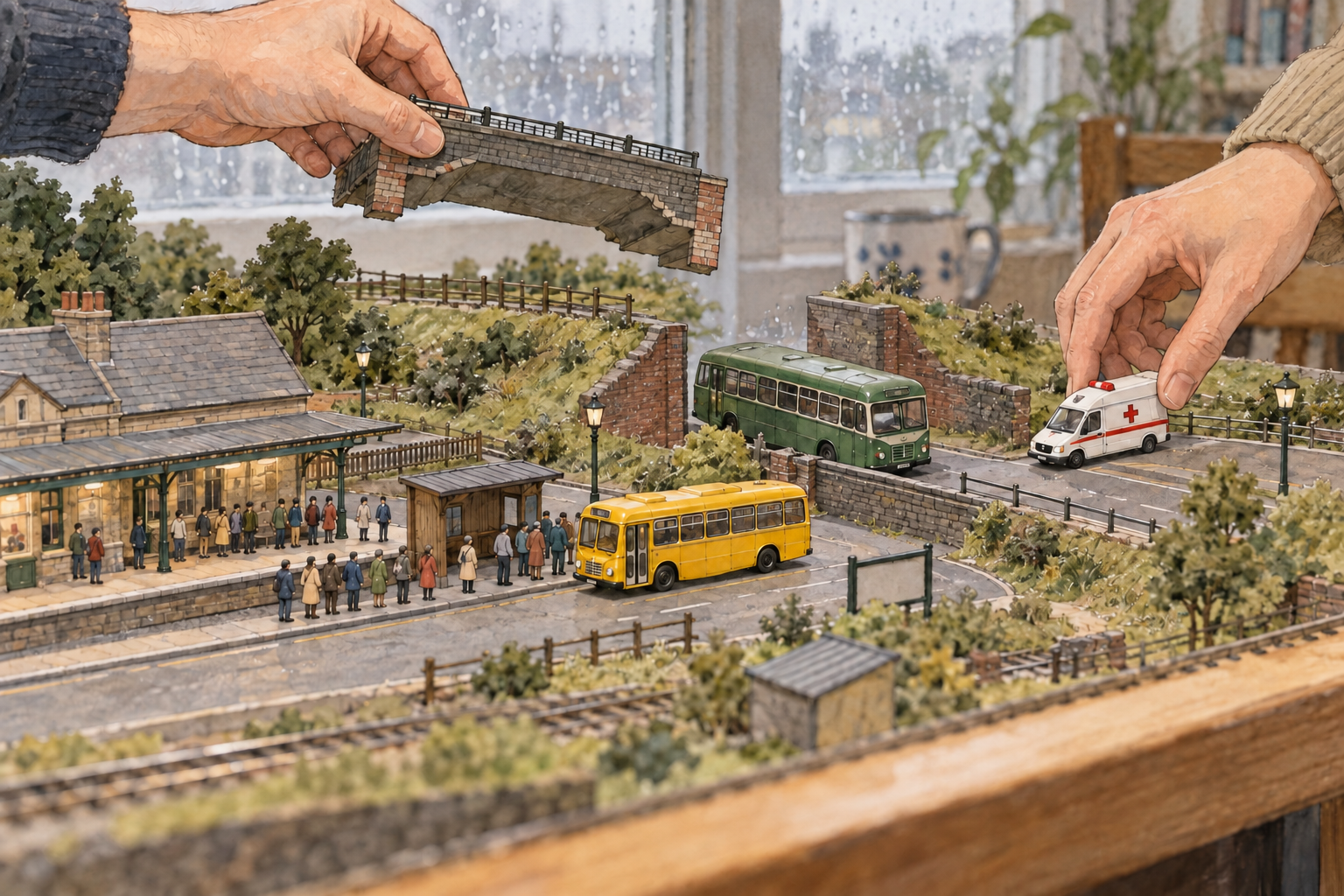
At eleven Ada put a bus outside the station.
Lionel stopped painting a chimney.
“What is that?”
“A bus.”
“I can see it's a bus.”
“Then you've saved yourself a question.”
The main line of the East Winton Model Railway Society had been out of action for three weeks. Lionel was waiting for a component. He had described it to Ada twice, in the voice he used for the deaths of people she ought to have heard of.
The bus was yellow. Nothing else in East Winton was yellow. Even the sun, painted on the far wall by a former member, had been subdued with a wash of grey.
“You can't just introduce a bus.”
Ada took a little sign from her cardigan pocket. RAIL REPLACEMENT SERVICE, it said. She leaned it against the station fence.
“It's not being introduced. It's covering.”
Lionel put down his brush. Through the real window, rain blurred the car park. The open afternoon began at two. Until then the whole town was theirs.
He went to the cupboard and came back with six passengers.
“Insufficient capacity,” he said.
“There's room for thirty.”
“Those are only the ones who booked.”
He opened the box marked CIVILIANS.
By half past eleven a queue stretched from the station doors to the cattle dock. A bride waited behind two identical men carrying newspapers. Lionel had placed a disappointed football team by the lavatory.
“Where are they going?” Ada asked.
“Connection at Lower Winton.”
“There isn't a Lower Winton.”
“There won't be a connection, either, at this rate.”
Ada fetched a second bus. It was red, with a missing wheel.
“Spare vehicle.”
“You can't put that on the road.”
“It's being inspected.”
She laid the mechanic beneath it, then changed her mind and stood him beside it with his arms folded. The mechanic's posture had been intended for a spectator at a cricket match, but it served.
Lionel disappeared into the kitchen. Ada heard a drawer open.
He returned with a square of paper on a cocktail stick.
BUS DRIVERS' REST ROOM.
He planted it beside the village tea shop.
“Where's the driver?”
“On his break.”
Ada looked in the yellow bus. Its driver was moulded into the seat.
“He's unusually conscientious,” she said.
Lionel stationed a second cricket spectator beside the first. The dispute had reached management.
At noon Ada diverted the queue to the church hall. Lionel pointed out that there was no church hall. Ada removed the church roof.
“Temporary accommodation.”
“You've left them in the rain.”
She replaced the roof, trapping the bride's raised arm under the eaves.
For some time they worked without speaking. Lionel added a policeman, two benches and a woman with a pram. Ada moved the footballers to the pub, where several already existed in a more cheerful pose. Neither remarked on the improvement.
Then Ada found the green bus.
It belonged to a different scale. Its wing mirrors brushed both sides of the high street. Lionel watched it approach the low bridge.
“That won't fit.”
“Not that way.”
She turned it sideways.
“Nor that way.”
Ada took the bridge off.
Under it was a pale rectangle no wider than her thumb. Lionel touched its edge, then went to the cupboard. She expected the regulations. Instead he brought out the small ambulance.
“Whose fault?” she asked.
“Too early to say.”
At two the first visitor found them examining a map of the county spread across the floor. Three buses stood nose to tail on the station approach. The passengers were back in their queue, now supervised by a man on horseback.
“Is anything running?” the visitor asked.
Lionel held up one finger. Ada was measuring the ferry with a piece of string.